Should You Refinish That Worn Dresser or Replace It?
What a piece is made of settles most of the question before money or memories even come into it.
October 26, 2026 · 4 min read
Most people reach this question the same way. A dresser or a dining table has been in the house for years, the top is worn, the finish has gone cloudy, and somebody says it might be time to buy something new. Before you decide, it helps to know what the piece is actually made of, because that answers most of the question for you.
Start with what the piece is made of
Solid wood is the easy case. If a table or chest is built from boards of oak, maple, cherry, walnut or mahogany, the finish is only a thin layer sitting on top of material that can be stripped, sanded and finished again, often more than once. A worn top on a solid wood piece is a surface problem, not a structural one. Furniture like that is nearly always worth refinishing, because what you'd buy to replace it rarely matches what you already own.
Veneer is the middle case, and it gets a bad reputation it doesn't deserve. Veneer is a thin slice of real wood glued to a core, and plenty of fine older furniture was made that way on purpose. It can be refinished too, but it needs a lighter hand because there is only so much wood to work with. We cover that in a separate article on what veneer really means. The short version: veneer is not a reason to give up on a piece.
Particle board and fiberboard with a printed or paper-thin surface are the hard case. Once the surface layer is gone, there is no real wood underneath to refinish, and water tends to swell the core for good. If your piece is that kind of furniture, replacing it may be the honest answer, and it's worth hearing that from a refinisher before you spend anything.
How to tell which one you have
Turn the piece over, or pull out a drawer, and look at the edges and the back. Solid wood shows grain that carries around corners and across the edge of a top. Veneer often shows a thin line where the surface layer stops, or a plainer, different wood underneath. Particle board looks like compressed sawdust, speckled and uniform, with no grain at all. If you can't tell, call the shop and describe what you see. Photos on your phone help.
The money question, in general terms
Prices aren't published for the shop's work, because every piece is different, so we won't guess at numbers here. What can be said in general is this. New solid wood furniture of decent quality costs real money. New furniture at the lower end is usually veneer over particle board or fiberboard, and it won't hold up the way an older solid piece will. When you compare, compare like with like: the cost of repairing and refinishing your piece against the cost of a new piece built just as well, not against the cheapest thing in the showroom.
One customer, Todd McCauslin, had a clock more than 225 years old restored in Westminster and wrote that the shop "does 10 star quality work without robbing the bank." A clock case is not a bedroom dresser, but the point carries over. Restoration doesn't always cost what people fear it will, and the only way to find out is to ask.
Sentiment counts, and so does what you'd be giving up
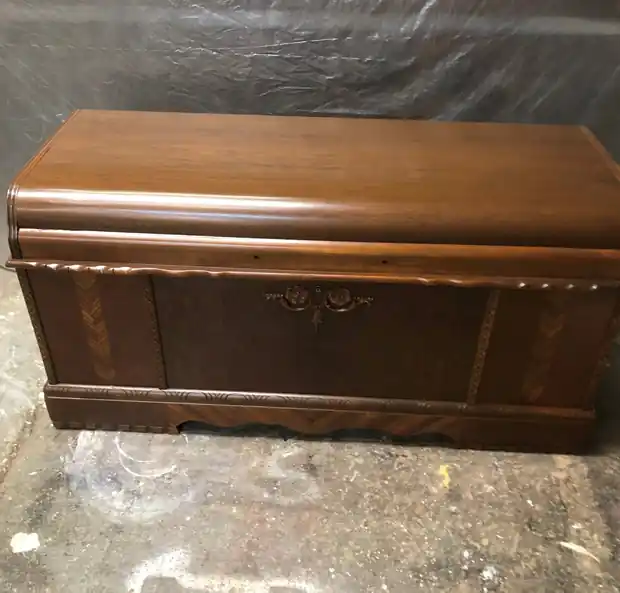
Some furniture is worth refinishing because of who owned it. Mary Stonesifer brought in a cedar chest from 1948 and wrote that David was "very personable and assuring that I will be happy with the refinishing of my 1948 Lanes Cedar Chest". A chest like that carries a family's history, and no new chest does.
Karen Anderson had a different reason. She wrote that David "completely updated, modernized my bedroom furniture", which was cherry she already owned. Refinishing doesn't have to bring a piece back to how it looked sixty years ago. A new finish can change how a whole room feels, and it often costs less than starting over with new furniture that's lighter and thinner than what you have now.
A simple way to decide
If you're still on the fence, run through these questions before you do anything permanent.
- Is the piece solid wood or good veneer? If so, lean toward refinishing.
- Is the frame sound, with joints that hold and no widespread swelling? A loose joint or a wobbling chair can be repaired, but it adds to the job.
- Would you love the piece with a fresh finish, or do you dislike the style itself? Refinishing changes color and sheen, not shape.
- Does it mean something to you or your family?
- Could you buy something built as well, in real wood, for about the same total?
If you're in or near Westminster, you can call David Teegarden at T-n-T Furniture Refinishing and talk it through before you commit to either path. The shop is open Monday through Friday, 9 to 2, by appointment for drop-offs, and you don't pay until you're satisfied with the work. The number is (410) 857-9353, or use the contact page.
T-n-T Furniture Refinishing, (410) 857-9353
Call (410) 857-9353More articles
What a White Ring or a Black Ring on Your Table Is Telling You
The color of the mark tells you how deep the damage goes, and that decides what you should do about it.
Why Veneer on Older Furniture Is Not a Defect
Veneered furniture is often better made than people assume, and a lifting corner is usually fixable.