Why Veneer on Older Furniture Is Not a Defect
Veneered furniture is often better made than people assume, and a lifting corner is usually fixable.
October 26, 2026 · 3 min read
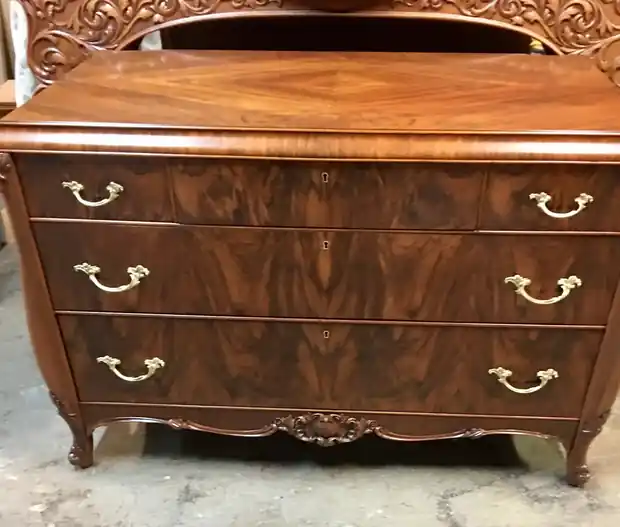
People hear the word veneer and think cheap. They'll look at an old dresser, see the top edge lifting, and decide the whole piece is junk. That reaction is understandable, because a lot of modern budget furniture really is a paper-thin surface over particle board. But veneer on an older piece of furniture is a different thing, and it's worth understanding before you throw out something that can be saved.
What veneer actually is
Veneer is a thin slice of real wood, glued to a thicker core. On quality older furniture, that surface layer is real mahogany, walnut, maple or another hardwood, and the core is usually solid wood or plywood. Cabinetmakers used it deliberately, not as a shortcut.
One reason is looks. The most dramatic grain in a tree, like the swirling flame figure in mahogany or the curls and burls in other woods, comes from parts of the trunk that can't be made into strong boards. Sliced thin, those parts can cover a whole chest front or tabletop. Cut in sequence and laid side by side, two slices mirror each other, which is called bookmatching. You'll see it on many fine chests and dressers, and it can't be done with a plain solid board.
The other reason is stability. Wide solid panels swell and shrink with the seasons and can crack. A veneered panel on a stable core moves far less. So a veneered top is often the more sensible construction, not the lesser one.
Why veneer starts to lift
Old veneer usually lifts because the glue under it has aged. Many older pieces were assembled with glues that soften over time, especially with heat and humidity swings. Add a spilled drink that seeped under an edge, a radiator nearby, or years of a humid Maryland summer followed by dry heated winters, and the bond lets go. Corners and edges go first, because that's where the layer is exposed.
A blister, which is a bubble in the middle of a surface, comes from the same cause: a patch where the glue has failed and the thin wood has bowed up. Both are repairable. Veneer work is on the list of things the shop at T-n-T Furniture Refinishing does, right alongside refinishing, wood repair and stripping.
How lifting veneer is generally repaired
The details vary from piece to piece, but the general approach is consistent. The loose area is cleaned out so fresh glue can grip. A suitable wood glue goes underneath, the veneer is laid back down, and it's held flat under even pressure while the glue sets, usually with a flat block and some protective paper between the clamp and the surface. A blister is typically opened along the grain, glued from inside and pressed flat, so the cut disappears. If a piece has chipped away, a matching piece of veneer can be inlaid and finished to blend in.
The key is saving everything. If a chip of veneer has come off, put it in an envelope and bring it with the piece. An original fragment, with its own grain and color, is the best possible patch.
What not to do
Please don't reach for superglue. It's brittle and it sets instantly, so you can't adjust the veneer once it touches. It tends to ooze out of the joint and show up as a hard, glossy stain that won't take finish. It also makes the professional repair harder, because the old glue has to be removed before proper glue can bond. A lifting corner glued badly at home often costs more to fix than the lifting corner did.
Don't sand a veneered surface to "get a fresh start." The layer is thin, and sanding through it exposes the core underneath, which can't be fixed by blending. Don't tape down a loose edge and forget it, don't pick at it, and don't pour water or use heat to try to relax it. Each of those makes a small repair bigger.
Is your piece worth saving?
Almost always, if the veneer is real wood. A lifting edge doesn't mean the piece is finished. It means the glue needs attention, which is routine for a shop that works on older furniture every day. If you're not sure what your piece is made of, describe it on the phone and have photos handy.
David Teegarden has more than thirty years of experience refinishing and repairing wood furniture in Westminster, and the shop doesn't ask for payment until you're satisfied. Call (410) 857-9353 or use the contact page to set up a time to bring a piece in.
T-n-T Furniture Refinishing, (410) 857-9353
Call (410) 857-9353More articles
Should You Refinish That Worn Dresser or Replace It?
What a piece is made of settles most of the question before money or memories even come into it.
What a White Ring or a Black Ring on Your Table Is Telling You
The color of the mark tells you how deep the damage goes, and that decides what you should do about it.